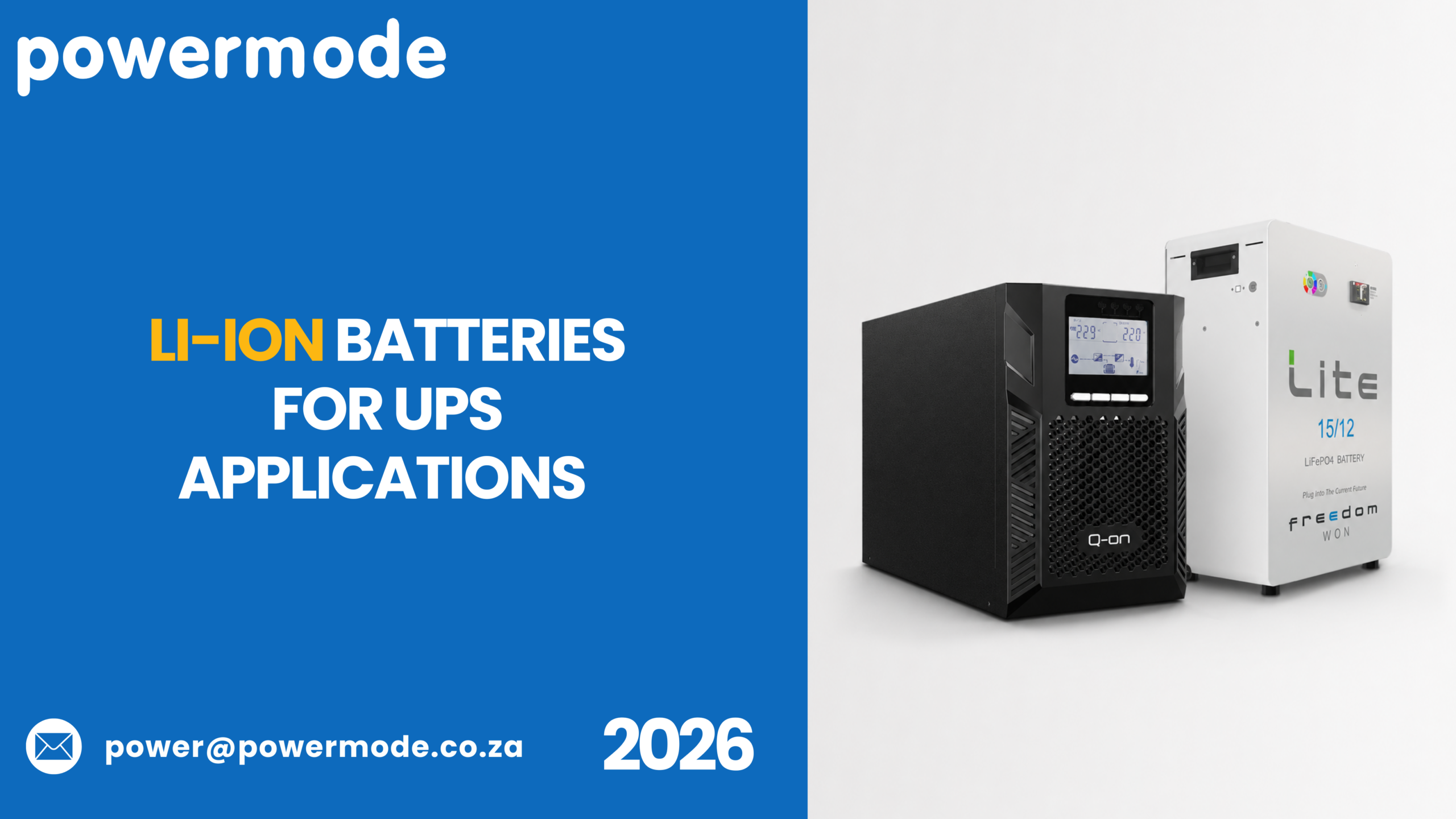
Introducing the Q-on ion-bank Li-ion Battery Interface for UPS installations.
Most UPS systems are designed to operate with banks of lead-acid batteries. UPSs with lead-acid batteries are becoming increasingly unreliable. Lead-acid batteries are typically rated for between 200 and 400 cycles, depending on depth of discharge (DoD) and operating temperature. In the Sub-Saharan region, however, power outages have become regular, if not daily occurrences. As a result, lead-acid battery life is currently measured in months, not years.
Recent decreases in the price of Li-ion battery technology have made Li-ion battery strings a competitive alternative to lead-acid batteries in UPS installations. The benefits of Li-ion batteries in standby UPS installations include increased reliability, heat resistance, longer run-time, increased life and improved ROI, amongst others. While factory integrated UPS solutions with Li-ion battery strings are available from selected manufacturers, they are normally prohibitively expensive and usually only short-run battery strings, not scalable for larger loads.
In order to meet this challenge, Powermode, a leading standby power specialist in the region, has developed the Q-on ion-bank Li-ion Battery Interface to connect Li-ion batteries to most single and three phase UPSs.
The Q-on ion-bank Battery Interface operates by connecting the UPS’s internal controller directly to the Li-ion battery via the battery’s CAN-bus connection. This enables the UPS’s charger to follow the limits that the battery’s Battery Management System (BMS) communicates continuously to the UPS. This optimizes charging speed, efficiency, fire safety, and Li-ion battery longevity.
The Q-on ion-bank Battery Interface is compatible with most UPS brands in both low and high voltage UPS categories, either as new, or an on-site upgrade.
The Q-on ion-bank Battery Interface is already widely installed and is compatible with most UPS brands.